
According to the Guardian, the Burmese Junta has launched a new offensive against the Karen people in northeastern Burma. There has been some suggestion that this new escalation of violence against Karen villagers is part of a strategy to cut off the Karen Nation Union (KNU) from civilian support in order to clear the way for a number of dams that they intend to build on the Salween River. Another suggestion (which comes from the Junta themselves) is that the Junta are clearing the areas that surround their new capital in Pyinmana. However, others claim that the offensives against civilians never stopped, despite the ceasefire agreement with the Karen National Liberation Army (KNLA) in 2004 (the KNLA is the military arm of the KNU), and that the only change has been renewed international attention.

The history of violence against the Karen people (and other ethnic minorities, like the Shan and Karenni) by the Burmese Junta is appalling. During their military rule over Burma, the Junta has consistently attacked, tortured and killed civilians, burnt down villages, employed a strategy of raping women, and driven villagers into forced labour (as porters for the army, and labourers for gas, infrastructure and dam projects).

To make matters worse, Thailand does not recognise the Refugee Convention, so when villagers attempt to flee torture, bloodshed, and systematic rape, they are not granted official protection in Thailand. Instead, they are either granted a place in one of few crowded refugee camps on the border, or they driven back into Burma unless they can escape notice and eek out a precarious living as an 'illegal' resident.

In 2004, I visited one of the biggest Karen refugee camps on the Thai-Burmese border. The Mae La refugee camp hosts some 200,000 people, in a tiny space in a valley near Mae Sot. While the people in the camp have been driven from their homes, and forced to subsist on food rations from the World Food Program, what was amazing was the level of organisation and community that existed in the camp. The Karen people have an incredible commitment to education, and every single child in the camp attends schools, which are run by the Karen people themselves (with the assistance of groups like ZOA, who provide teacher training and some resources).

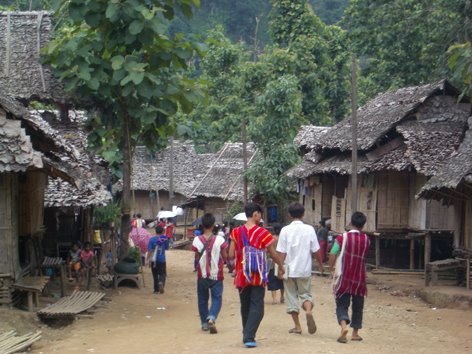 The schools go from preschool to the end of high school, and there was some talk of introducing the International Baccalaureate in order to give the children qualifications that they could take anywhere. I was there to talk about teaching some post-secondary courses to the children who had graduated and wanted to do some more academic studies rather than going on to the Tech courses that they had available - in mechanics, cooking, and textiles.
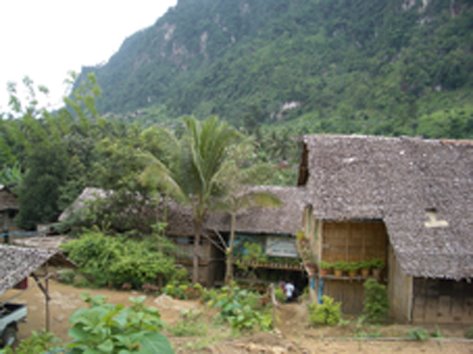 What struck me was that many of these children had never left the tiny area of the Mae La refugee camp, and without a change of government in Burma, might never do so. Here were thousands of children with 12-13 years education, good English, and ambition, and they were stuck in a refugee camp where their only options were to become a teacher, one of a small number of community leaders, or to weave textiles for tourist money. What kind of world allows that to happen? What a ridiculous waste.
 [Photos from inside Burma from Earthrights International. Photos from Mae La are mine]


No comments:
Post a Comment